

Businesses are rapidly moving away from traditional phone systems to cloud-based alternatives, and with good reason. Lower costs, seamless remote access, and a rich set of enterprise-grade features make cloud phone systems an attractive option for organizations of every size. But like any technology investment, the switch comes with trade-offs that deserve careful consideration before you commit.
If you are weighing whether to switch your business phone system to the cloud, this guide covers every advantage, every trade-off, and the exact questions you need to ask before committing. By the end, you will have a clear, honest picture of whether a cloud phone system is the right move for your business right now.
✨TL;DR
- Cloud-based phone systems offer lower costs, instant scalability, remote-work support, and advanced features that legacy systems cannot match
- The main drawbacks are internet dependency, ongoing subscription fees, and potential call-quality issues on congested networks.
- For most modern businesses, the benefits far outweigh the limitations, but the right decision depends on your existing infrastructure, team size, and industry requirements
What is a cloud-based phone system?
A cloud-based phone system, also called a VoIP (Voice over Internet Protocol) phone system or hosted PBX (Private Branch Exchange), is a business communications service delivered entirely over the internet. Instead of running on physical hardware installed at your office (as a traditional on-site PBX does), the phone system is hosted and managed in secure, off-site data centers by a cloud PBX or VoIP service provider.
When you make or receive a call, your voice is converted into digital data packets and transmitted over your internet connection, just like email or a video stream. The provider handles routing, maintenance, security patches, and redundancy automatically, with no IT intervention required on your end.
Pro Tip:Common names for this technology: Cloud PBX, IP PBX, hosted PBX, VoIP phone system, virtual phone system, and UCaaS. These terms all describe the same fundamental model: phone service hosted off-site and accessed over the internet.
Cloud phone system pros and cons at a glance
Cloud phone systems provide outstanding flexibility for modern hybrid teams, but they trade the physical reliability of traditional copper-wire lines for internet dependency.
For companies looking to reduce communication costs and enable remote work, moving to the cloud is usually the right call, as long as they invest in a high-speed connection and configure Quality of Service (QoS) settings to prioritize voice traffic.
Here is a quick side-by-side comparison:
| Cloud phone system pros | Cloud phone system cons |
| No hardware investment, predictable monthly fees | Ongoing subscription costs per user |
| Add/remove users instantly | Dependent on the provider’s infrastructure |
| Works from any device, anywhere | Requires a stable internet connection |
| Call forwarding, video conferencing, and CRM integration | Some advanced features are locked behind higher plans. |
| Built-in redundancy and business continuity | Internet outages disrupt all calls |
| Provider handles all updates automatically | Less control over infrastructure |
| HD voice quality with good bandwidth | Jitter/latency issues on poor networks |
Benefits of a cloud-based phone system
Here is a deeper look at why hundreds of thousands of businesses have switched from legacy PBX or on-premises phone systems and traditional phone lines to cloud telephony.
Lower costs
Cost reduction is consistently the top driver of cloud phone adoption. Traditional phone systems require substantial upfront capital: PBX hardware, on-site servers, specialist cabling, and ongoing IT maintenance contracts. With a VoIP service, you replace all of that with a predictable monthly subscription, and the savings extend well beyond the obvious hardware line items

Key cost savings include:
- No hardware investment, use existing computers, mobile apps, or affordable VoIP desk phones.
- Lower international calling costs compared to traditional PSTN lines.
- No dedicated PBX server to purchase, host, or maintain.
- Unlimited domestic calling is included in most plans.
- Reduced maintenance costs, the provider handles all infrastructure.
- Software updates and security patches are applied by the provider at no extra charge.
Businesses that switch from on-premises PBX to cloud telephony typically reduce their communication costs by 30–50%, with savings accelerating at scale. Pricing for cloud phone plans generally ranges from $15 to $50 per user per month, depending on the provider and feature tier, and is far lower than the total cost of ownership for comparable on-premises hardware.
See KrispCall’s pricing plans
Easy scalability
With a traditional phone system, adding a new user means procuring hardware, arranging an engineer visit, running cabling, and waiting days or weeks. With a cloud system, you add a new user in minutes via a web dashboard, no physical work, no waiting, no specialist required.
Here, you can remove users, temporarily suspend licenses, or downgrade plans without penalties, something traditional hardware-based systems simply cannot offer. This makes cloud telephony ideal for
- Startups growing rapidly and hiring ahead of their infrastructure.
- Seasonal businesses with fluctuating call volume throughout the year.
- Companies with distributed or remote teams across multiple locations.
- Enterprises opening new offices or expanding into new markets.
Work from anywhere
A cloud-based phone system works on any internet-connected device, such as a desk phone, laptop, softphone, or mobile app. Employees can make and receive calls, access voicemail, join conference calls, and use all standard business calling features from home, a coffee shop, or anywhere in the world, all using the same business phone number.
This matters beyond mere convenience. Remote and hybrid work have become baseline expectations for employees, and businesses that can offer seamless communication and collaboration tools, regardless of location, gain a tangible advantage in recruitment and retention.
More importantly, a cloud phone system provides inherent business continuity: if a natural disaster, power outage, or any event prevents access to your office, call routing continues from any location the moment team members are online. On-premises phone systems cannot offer this without expensive redundant hardware installed at a secondary site.
Advanced features
Cloud phone systems include far more features than traditional landlines or legacy phone systems, often at no extra cost. This comes with a full unified communications suite included in even entry-level plans, features that were previously accessible only to large enterprises with dedicated telephony budgets
Common features included with cloud VoIP systems:
- Intelligent call routing and IVR (interactive voice response) menus.
- Call forwarding, queuing, and automatic callbacks.
- HD video calling and video conferencing.
- Instant messaging and team chat within the same platform.
- Voicemail-to-email transcription, delivered directly to your inbox.
- Call recording, storage, and on-demand playback.
- Real-time analytics and historical call reporting dashboards.
- CRM integration (Salesforce, HubSpot, Zoho, and others) for automatic call logging.
- Auto attendant to professionally greet and route callers 24/7.
- International calling at reduced rates across 160+ countries.
Better customer experience
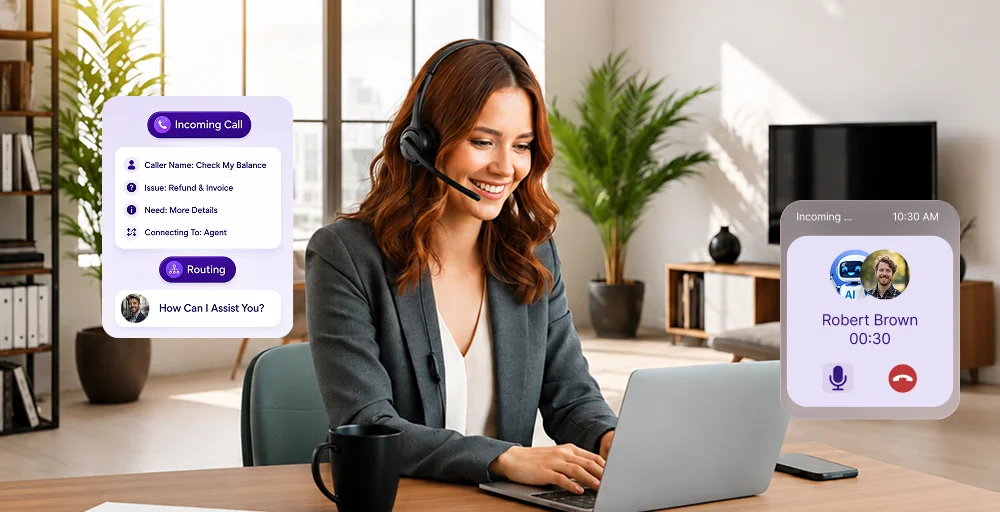
Customers expect fast, frictionless, professional communication. Cloud-based phone systems are built to deliver exactly that. Intelligent call routing ensures callers reach the right person or team without being transferred multiple times. Queue management with real-time wait time announcements reduces frustration.
CRM integration means your agents see customer history, open tickets, and account details the moment a call connects, enabling personalized, efficient service rather than generic interactions. Real-time supervisor dashboards let team leaders monitor call volumes, wait times, and agent performance, enabling them to intervene instantly when experience metrics dip.
Drawbacks of a cloud-based phone system
No technology is without limitations. Understanding these drawbacks before you switch is the difference between a smooth deployment and an expensive lesson. Consider them before switching.
Internet dependency
The biggest drawback of a cloud-based phone system is its reliance on an internet connection to function. Unlike traditional PSTN phone lines, which operate independently of your internet connection, VoIP calls fail entirely when your connection goes down. There are no phone calls in or out.
This means:
- Internet outages mean no phone service until connectivity is restored.
- Emergency services calls (999 in the UK, 911 in the US) may behave differently on a VoIP provider; verify your provider’s emergency call handling before deployment
- Businesses in areas with poor broadband face ongoing reliability challenges
Mitigation: Use a backup 4G/LTE connection, maintain a stable internet connection with adequate bandwidth, and ensure your provider offers failover routing.
Ongoing subscription costs
While cloud phone systems eliminate large upfront hardware costs, they introduce recurring per-user, per-month costs. For small teams, this is almost always a net saving. For very large teams with modest feature requirements, the per-user fees can add up, especially when advanced features require upgrading to higher-tier plans.
Typical plans range from $15 to $50 per user per month, depending on the provider and feature tier. Always map your required feature set against each pricing tier before committing, and check for annual billing discounts; most providers offer 15–25% savings compared to monthly billing
Call quality issues
VoIP call quality is determined by your network, not the phone system itself. Issues such as network jitter (irregular packet delivery), packet loss, and latency can cause choppy audio, echo, delays, or dropped calls, none of which occur on dedicated copper phone lines.
As a general rule, plan for approximately 100 Kbps of dedicated bandwidth per concurrent call. A business with 20 simultaneous calls needs at least 2 Mbps reserved for VoIP traffic. Common causes of poor call quality include:
- Insufficient bandwidth for the number of concurrent calls
- Network congestion during peak business hours
- Poor Wi-Fi vs. wired Ethernet connections
- Outdated routers are not optimized for VoIP traffic
Setup and network requirements
Switching from traditional phone systems to a cloud-based VoIP system requires some upfront planning. You’ll need to assess your network infrastructure, ensure adequate bandwidth, configure Quality of Service (QoS) settings, and potentially upgrade your routers or switches.
What setup typically involves:
- Network assessment, bandwidth per concurrent call (approx. 100 Kbps per call)
- QoS configuration to prioritize VoIP traffic
- Number porting from existing phone lines
- Training staff on the new system and mobile apps
- Integrating with existing customer relationship management (CRM) and business tools
Most modern business applications, cloud phone providers, including KrispCall, offer dedicated onboarding support to guide you through network assessment, number porting, and staff training. Run a VoIP technology readiness test first and confirm your router supports QoS configuration before switching
Conclusion: Is a cloud phone system worth it?
Cloud-based phone systems offer several advantages, including lower upfront and ongoing maintenance costs, instant scalability for growing teams, seamless remote work across various devices, and advanced features such as CRM integrations and call analytics.
These benefits far outweigh the drawbacks, which include reliance on internet connectivity, recurring per-user fees, and occasional latency on weak networks. For businesses with anywhere from 5 to 5,000 users, upgrading to a cloud-based system is a wise decision, especially when risks are mitigated with quality of service setup and LTE backups.
If you are planning to switch to a cloud-based telephony system, switch to KrispCall for reliable cloud phone services. Plans start at just $15 per user per month. Enjoy 99.99% uptime, easy integration with Salesforce and HubSpot, and advanced tools without the stress.
Book a free demo with KrispCall and elevate your business calls today!