

We compared and reviewed the top AI phone systems based on real-world performance, automation depth, feature value, and pricing to help you find the right fit for your business.
Finding the best AI phone systems isn’t just about ticking boxes on a feature list. It’s about how those features perform in real-world business cycles. We’ve reviewed and analyzed more than 30 leading artificial intelligence phone systems to determine which platforms deliver for modern business teams.
✨ Here are our top 10 AI phone systems:
- Dialpad: Best overall AI phone system for business with industry-leading real-time transcription.
- KrispCall: Top choice for startups needing high-quality global VoIP AI phone systems with extensive CRM integrations.
- RingCentral: Best for large teams requiring a comprehensive, scalable UCaaS suite with deep AI insights.
- CloudTalk: Best AI phone system for sales teams focused on high-volume outbound dialing and efficiency.
- Nextiva: Best for unified customer journeys, blending CRM integrations with powerful AI call summaries.
- Weave: Best for healthcare and home service providers needing a specialized AI receptionist.
- Aircall: Best for support teams seeking an easy-to-use interface and seamless helpdesk integration.
- Allo: Best for collaborative teams that need an AI-first approach to visual and voice data.
- Quo: Best AI answering service for high-growth lead qualification and automated intake.
- Goodcall: Best affordable and simple IVR AI system for solopreneurs and very small local shops.
Why can you trust this guide?
We don’t pick favorites based on marketing budgets or vendor claims. Every platform here was evaluated using the same criteria, including AI features such as call transcription and sentiment analysis, CRM integration depth, call quality, pricing, and scalability as a business grows.
Our research draws on verified user reviews on G2, Capterra, and Trustpilot, as well as feedback from sales managers, IT admins, and support leads who use these platforms daily. We cross-referenced that with case studies and platform documentation to separate real capability from marketing fluff.
No paid placements. Just an honest breakdown of what each provider does well and where it falls short.
Best AI phone systems in 2026 (Quick Comparison Table)
| Tool | Best for | AI Capabilities Score (10) | Automation Level | Starting Pricing | ROI Score |
| Dialpad | High-growth sales teams | 9.2 | Very high | $15 user/month | 9.5 |
| KrispCall | Distributed SMBs & internationally expanding startups | 7.4 | Medium | $12/user/month | 9.1 |
| RingCentral | Large enterprises UCaaS | 8.53 | High | $20/user/month | 8.5 |
| CloudTalk | High-volume outbound sales | 8 | High | $19/user/month | 8.2 |
| Nextiva | Customer experience (CX) management | 8.14 | High | $15/user/month | 8.1 |
| Weave | Small healthcare & dental, optometry practices | 7.47 | Medium high | $249/month | 7.5 |
| Aircall | Sales & support teams using popular CRMs | 7.45 | Medium high | $30/license | 7.4 |
| Allo | Small & mid-sized sales (SMBs) | 6.88 | Medium | $18/user/month | 6.9 |
| Quo | Startups & small teams | 6.69 | Medium | $15/user/month | 6.7 |
| Goodcall | Solopreneurs & local service business | 5.9 | Medium | $66/agent/month | 6.2 |
Here:
- AI CAPABILITY SCORE means: how advanced and useful the AI features are in real business scenarios.
- AUTOMATION LEVEL: Measures how much of the call workflow is handled without human input.
- ROI SCORE: Measures how much value the tool generates vs its cost. E.g., hours saved, lower cost.
Top 10 AI phone systems for businesses (Detailed Comparison)
1. Dialpad
Dialpad is widely considered the best AI phone system for business because of its proprietary, built-in machine-learning engine, DialpadGPT. This allows the system to process Natural Language Processing (NLP) locally, resulting in some of the fastest and most accurate call transcription in the VoIP industry.

For businesses seeking an AI phone system that turns every conversation into a searchable, actionable data asset, Dialpad is the clearest starting point.
Core AI capabilities
- AI live coaching: Provides real-time assist cards to agents, popping up helpful notes or technical answers based on what the caller is saying.
- AI CSAT: Predicts customer satisfaction scores for 100% of calls, eliminating the need for manual post-call surveys.
- Real-time sentiment analysis: Uses conversational AI to track the mood of a call as it happens and flags moments of friction, frustration, or buying intent in real time.
- AI transcription: Transcribes the live call into a searchable record, ensuring every detail is captured.
- Call scoring AI: Calls are automatically scored based on talk ratios, keyword usage, and engagement.
Unique advantage
The standout feature is the Company Dictionary. You can train the Dialpad AI on your specific brand names, industry jargon, and competitor terms. This drastically improves the accuracy of Speech Recognition, ensuring that niche technical terms don’t get lost in translation during call routing or logging.
Limitations
- The mobile app experience, while functional, doesn’t fully match the desktop version.
- Its AI features are less integrated into its video and team messaging tools compared to its voice suite.
Pricing breakdown
- Dialpad pricing & plans start at $15/user/month
- Dialpad Connect plan offers three subscription plans:
- Standard: $15/user/month (billed annually)
- Pro: $25/user/month (billed annually)
- Enterprise: Contact sales teams
- A 14-day free trial is available to try Dialpad Connect before committing.
Best use case
Sales and Support Teams. Dialpad is the top choice for high-volume environments where call scoring AI and live coaching can directly impact conversion rates and customer retention.
G2 review
What users are saying
“Dialpad is a simple-to-use VoIP client with great AI tools for recapping and summarizing meetings. The website is easy to navigate, and the admin area makes it straightforward to view reports and see real-time user activity.”
2. KrispCall
KrispCall is one of the best AI phone systems for startups and global teams that need to scale fast without a heavy IT lift. It’s an easy-to-use platform that allows businesses to instantly grab virtual numbers in over 100 countries.
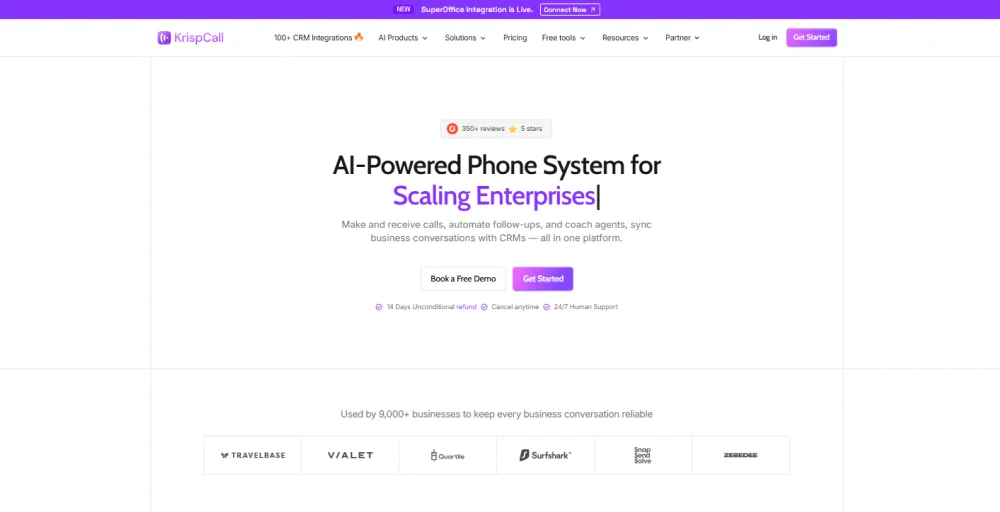
By blending cloud telephony with an intuitive Unified Callbox, it centralizes all calls, SMS, and voicemails into a single workspace, making it a top-tier choice for remote-first companies.
Core AI capabilities
- Call transcription: Every call is automatically transcribed and stored alongside the contact record.
- AI reply: Inbound text messages receive AI-generated suggested responses based on conversation context.
- Call summary: Generate a clean summary after each call covering the key discussion points and outcomes.
- AI text message responder: Automatically send a smart, context-aware text reply when an inbound call is missed, keeping the customer informed and engaged.
- AI rephrasing: Instantly rewrite SMS replies to improve the accuracy and match the tone of the conversation.
Unique advantage
KrispCall stands out by embedding its AI Copilot directly into a Unified Callbox, bringing calls, SMS, and voicemails into one shared team queue.
This setup allows tools like call transcription and AI rephrasing to work alongside deep CRM integrations with HubSpot and Salesforce, automatically syncing data without switching apps
Limitations
- AI rephrasing currently supports English only, which may be a limitation for multilingual teams.
- The entry-tier plan caps teams at five users, meaning growing teams may need to upgrade sooner than expected.
Pricing breakdown
- KrispCall affordable voice solution starts at just $12/user/month
- KrispCall offers three subscription plans:
- Essential: $12/user/month (billed annually)
- Standard: $30/user/month (billed annually)
- Enterprise: Custom
- For every user, one local/mobile number from the UK or one local number from either the USA or Canada is available for free upon sign-up.
Best use case
KrispCall is the strongest AI phone system for startups and freelancers that want global number coverage, practical AI that reduces manual work, and seamless CRM connectivity without paying enterprise prices.
G2 review
What users are saying
“I like how KrispCall is simple to use and quite efficient. It’s very convenient to connect with my overseas clients through SMS, and having a local number while sitting in India is a big plus. The MMS feature is a great help, especially when people send photos. Compared to other apps I’ve used, KrispCall is more satisfactory in terms of call connectivity.”
3. RingCentral
RingCentral is one of the most established names in cloud telephony, offering a scalable AI-powered phone system. Known for its 99.999% uptime reliability, it has transitioned from a traditional VoIP provider into a full-scale intelligent business calling platform.

It’s designed for organizations that need a high-security, all-in-one suite for voice, video, and messaging with deep Machine Learning insights built into every layer.
Core AI capabilities
- RingSense AI: A powerful Conversational AI engine that provides real-time sentiment analysis calls and keyword tracking.
- AI receptionist (AIR): A sophisticated virtual receptionist that uses Natural Language Processing to route calls more accurately than a standard auto attendant.
- AI call summaries: Post-call and post-meeting summaries are generated automatically, with searchable highlights, key moments, and speaker-filtered playback.
- AI video features: Includes advanced meeting insights that create transcripts and short video highlight reels of recorded calls.
- Live call transcription: AI-generated transcriptions, notes, and closed captioning are available across both voice and video calls.
Unique advantage
RingCentral’s biggest strength is its ability to serve as the single system of record for voice, video, messaging, contact center, and workforce engagement under one roof. Its AI Receptionist has become a breakout product for SMBs, handling 90% of inbound call routing without human intervention.
Limitations
- AI features like RingSense for Sales and the AI Receptionist are paid add-ons or not included in any base plan.
- Even on higher plans, SMS is capped at 200 texts per user, with additional SMS bundles purchased separately.
Pricing breakdown
- RingCentral’s RingEX plan starts at $20/user/month
- RingCentral pricing plans include four subscription plans:
- Core: $20/user/month (billed annually)
- Advanced: $25/user/month (billed annually)
- Ultra: $35/user/month (billed annually)
- Customer Engagement Bundle: Contact the sales team
- Every new subscriber gets a 14-day free trial with support for up to 20 phone lines.
Best use case
RingCentral is the strongest choice for large teams and enterprises that need a single, scalable platform managing communication across voice, video, messaging, and contact center channels. It’s particularly well-suited for organizations with compliance requirements, international operations, or complex call routing needs across multiple sites.
G2 review
What users are saying
“I love how interactive RingCentral Contact Center is. It’s very easy to use and user-friendly. It doesn’t crash and is easy to set up and customize. It allows me to make calls freely and independently while working remotely, and it makes communication with clients much easier.”
4. CloudTalk
CloudTalk is a high-velocity intelligent business calling platform engineered specifically for outbound sales and customer service teams. While other VoIP phone systems focus on general office use, CloudTalk is built for volume.

It bridges the gap between traditional cloud telephony and modern Conversational AI, offering a suite of power dialing tools that integrate directly into your sales stack to turn every call into a data-driven growth opportunity.
Core AI capabilities
- AI voice agent (CeTe): A fully autonomous voicebot that can handle inbound support or perform outbound lead qualification without human intervention.
- Sentiment analysis: Tracks customer emotions during calls to help guide agent responses according to the tone of the conversations.
- Automated call scoring AI: Calls are automatically scored against predefined criteria to identify coaching opportunities.
- Smart notes & summaries: Leverages Natural Language Processing to capture key takeaways and AI call summaries, instantly syncing them to your CRM.
- Call transcription: Transcribe each call automatically in multiple languages in real-time to improve the efficiency of your team.
Unique advantage
CloudTalk’s true power lies in its Smart & Power Dialers combined with AI-driven insights. It dials faster, uses call analytics to identify the best times to call, and provides reps with real-time sentiment analysis during conversations.
Limitations
- AI Conversation Intelligence and Voice Agents are paid add-ons to the base subscription, which can drive costs higher than the advertised per-seat price suggests.
- CloudTalk is primarily a voice platform, so if you need video conferencing, you’ll need to integrate with additional tools.
Pricing breakdown
- CloudTalk’s pricing & plans start at $19/user/month
- CloudTalk includes three paid subscription plans:
- Lite: $19/user/month (billed annually)
- Essential: $29/user/month (billed annually)
- Expert: $49/user/month (billed annually)
- A 14-day free trial is available for new users to test.
Best use case
CloudTalk is the strongest AI phone system for high-growth sales teams. It is the top choice for outbound teams and SDRs who do cold outreach, manage large pipelines, and deploy contact center software, where call efficiency directly drives revenue.
G2 review
What users are saying
“What I like most about CloudTalk is its user-friendly interface and reliable call quality. It’s easy to navigate, even for new team members, and the analytics features are very helpful for tracking performance and monitoring productivity.”
5. Nextiva
Nextiva has been in the business phone system space for nearly two decades. Its flagship suite, NextivaONE, bundles voice, video, SMS, team chat, and AI into one workspace. Serving around 150,000 businesses, Nextiva combines voice, video, chat, and collaboration tools into a unified platform with a claimed 99.999% uptime.

Core AI capabilities
- Voicemail transcription: Converts audio messages into high-accuracy text, delivered via email or SMS, enabling faster prioritization of after-hours inquiries.
- NextIQ AI answer assist: A real-time agent copilot that suggests answers to customer questions during live calls.
- Xbert AI (AI receptionist): A sophisticated virtual receptionist capable of booking appointments and answering FAQs in a natural, human-like way.
- Context-aware routing: Skills-based routing sends callers to the agent best equipped to handle their specific issue based on language, expertise, or availability.
- AI call notes & summaries: Automatically generates searchable AI call summaries and captures key action items.
Unique advantage
Nextiva’s standout feature is its Journey Orchestration. The system tracks every touchpoint, from a Yelp review to a phone call, and the AI can provide sentiment analysis that covers the entire relationship.
Which means, if a customer is frustrated on social media and then calls in, your team sees that context immediately through the CRM integration, allowing for much more empathetic and effective support.
Limitations
- Real-time transcription, AI call notes and summaries, and NextIQ AI Answer Assist are only available on the Scale plan at $75/user/month.
- CRM integrations, including Salesforce and HubSpot, are listed as add-ons on every plan, including Scale.
Pricing breakdown
- Nextiva’s pricing and plans start at $15/user/month.
- Nextiva’s small business plan offers three primary tiers:
- Core: Starting at $15/user/month (billed annually)
- Engage: Starting at $25/user/month (billed annually)
- Scale (Power Suite CX): Starting at $75/user/month (billed annually).
Best use case
Nextiva is the strongest fit for businesses where phone communication is mission-critical. It’s particularly well-suited for teams that want customer support automation, AI-assisted call handling, and a full-picture view of the customer journey.
G2 review
What users are saying
“I really appreciate how Nextiva makes it easy for us to communicate within the firm, especially since many of us work remotely now. It’s great for keeping everyone in touch, even when we’re not in the same office. I would say overall, it’s easy to use. They’re pretty good about the setup. Once it’s set up, it’s like set it and forget it, and it was done well with no issues.”
6. Weave
Weave is a specialized customer engagement platform designed for high-touch local businesses like dental clinics, veterinary offices, and home services. By combining VoIP with deep, industry-specific practice management software, Weave ensures that every time the phone rings, your staff sees a complete caller profile.

It is the best AI phone system for teams that need to balance professional cloud telephony with the intense scheduling demands of a local storefront.
Core AI capabilities
- Call intelligence: Uses a custom generative AI model to automatically transcribe calls, detect patient sentiment, and identify missed revenue opportunities.
- AI receptionist: An always-on AI voice agent that handles after-hours calls, answers FAQs, and books appointments directly into your calendar.
- Smart missed call texting: Automatically triggers an AI-powered text response to missed calls, engaging the lead immediately.
- Voicemail transcription: Delivers text versions of voicemails to your inbox, making it easier to triage urgent requests during a busy shift.
- Call pop: Displays patient contact and appointment details on screen the moment an inbound call connects.
Unique advantage
Weave’s biggest edge is specificity or exactness. Its AI models are trained on over a decade of call, text, and voicemail data from healthcare practices, giving it a depth of contextual understanding that general-purpose AI phone systems can’t replicate out of the box.
It integrates natively with practice management systems like Dentrix and Eaglesoft, automatically syncing patient contact data and appointment records.
Limitations
- Customer support quality is a recurring complaint. Multiple reviewers report slow response times, inconsistent resolution, and difficulty reaching senior support staff.
- Weave is built for voice, text, and appointment workflows but not designed for high-volume outbound sales, SIP trunking environments, or enterprise contact center software use cases.
Pricing breakdown
- Weave offers a customized solution using a per-location flat-rate model.
- Weave includes three primary rivers designed for specialized practice needs:
- Pro: $249/month per location
- Elite: Custom pricing
- Ultimate: Custom pricing
- Practices can book a personalized demo to evaluate the AI feature and specific integration capabilities.
Best use case
Weave is the strongest AI phone system for independent healthcare practices as well as home service businesses that need to automate their front desk while maintaining a high-end, personalized feel for their clients.
G2 review
What users are saying
“I believe the most helpful thing about Weave is the preset templates that can be made to send clients messages. I love how easy Weave is to use.”
7. Aircall
Aircall has built a reputation as the easiest-to-use cloud telephony solution for modern customer-facing teams. In a market full of complex enterprise communication tools, Aircall stands out for its minutes-to-deploy setup and a minimalist interface that removes the friction from high-volume customer support automation.

Core AI capabilities
- AI assist & summaries: Automatically generates AI call summaries, identifies key topics, and extracts action items.
- AI voice agent: Handles after-hours and overflow calls around the clock, answering questions and routing complex issues to live agents with full conversation context.
- Sentiment analysis: Sentiment is tracked across calls to help teams identify friction points, flag conversations that need attention, and surface coaching moments.
- Automatic AI tagging: Leverages Natural Language Processing to suggest the most relevant tags for a call, ensuring your call analytics stay organized.
- Transcription redaction: Uses Machine Learning to automatically redact sensitive information (like credit card numbers or PII) from call transcription for security and compliance.
Unique advantage
Aircall offers over 250 one-click integrations that connect the phone system to CRMs, help desks, and business tools. For support teams already running Zendesk or Intercom, and sales teams inside HubSpot or Salesforce, Aircall slots in without disrupting existing workflows.
Limitations
- The Essentials plan requires a minimum of 3 seats, immediately ruling it out for solopreneurs or very small teams that need only a single business line.
- Aircall has no native video conferencing. Teams that need voice and video under one roof will need a separate tool.
Pricing breakdown
- Aircall pricing is based on a per-license model with a 3-seat minimum required to get started.
- Aircall includes three primary subscription plans:
- Essentials: $30/license/month (billed annually)
- Professional: $50/license/month (billed annually)
- Custom: Custom pricing (requires a 25-seat minimum)
- Every plan includes unlimited inbound and internal calls, but excludes toll-free calls.
Best use case
Aircall is the strongest pick for sales and support teams needing a cloud-based phone system, balancing dedicated sales tools and intelligent contact center features across all subscription levels. It is the top choice for teams that live in their helpdesk and need a scalable, integrated solution to handle high call volumes with personalized service.
G2 review
What users are saying
“Ease of use and quick implementation. The interface is intuitive, operates 100% in the cloud, and integrates very well with tools like CRM and helpdesks, which facilitates call management and improves team productivity without the need for complex infrastructure.:
8. Allo
Allo is an AI-first intelligent business calling platform built specifically to eliminate manual administrative tasks for small sales and support teams. Allo integrates Machine Learning at its core to automate the entire call lifecycle.

It offers features like unlimited calls, AI summaries, CRM integrations, and call recording, all included in the base plan, making it one of the best AI phone systems for small businesses.
Core AI capabilities
- AI receptionist: Handles calls 24/7, qualifies leads, blocks spam, and books appointments automatically.
- AI call transcription: Every call is recorded and transcribed automatically, with notes taken and everything made searchable.
- Missed call text back: When a call goes unanswered, Allo automatically sends a custom text message to let the caller know they’ll hear back soon.
- AI IVR: Rather than traditional “press 1, press 2” menus, Allo’s IVR uses natural language processing to detect caller intent and route intelligently.
- AI assistant: Uses calls and texts as a live knowledge base to follow up, draft next steps, and stay on top of what’s happening in every active relationship.
Unique advantage
The defining feature of Allo is its Zero-Manual-Follow-up philosophy. While other AI VoIP providers provide transcripts, Allo’s AI Copilot proactively suggests the next move, whether that’s drafting a text or updating a deal stage in your CRM.
Limitations
- Allo currently focuses on voice and does not offer built-in video meetings or native support for messaging platforms like WhatsApp or Instagram.
- Some users report dropped calls, temporary number outages, or minor connection instability, particularly in certain regions outside the US.
Pricing breakdown
- Allo’s pricing model is all-inclusive with tools like AI summaries and CRM syncing baked into the core price.
- Allo includes two primary subscription plans:
- Starter: $18/user/month (billed annually)
- Business: $32/month (billed annually)
- A 7-day free trial is available for new users to test the platform on mobile and desktop.
Best use case
Allo is the strongest AI phone system for small business teams, particularly solopreneurs, lean sales operations, and remote-first teams. It is the top choice for lean organizations that want a mobile-first, genuinely AI-native calling platform without the complexity or cost of an enterprise tool.
G2 review
What users are saying
“What I particularly appreciate about Allo is the call summaries and the ability to search through different calls to obtain a summary of recurring patterns in the exchanges.”
9. Quo
Quo, fully rebranded from OpenPhone with a fully redesigned AI layer built around the Sona voice agent in late 2025. It’s a modern, app-centric, intelligent business calling platform designed for startups and fast-moving teams.
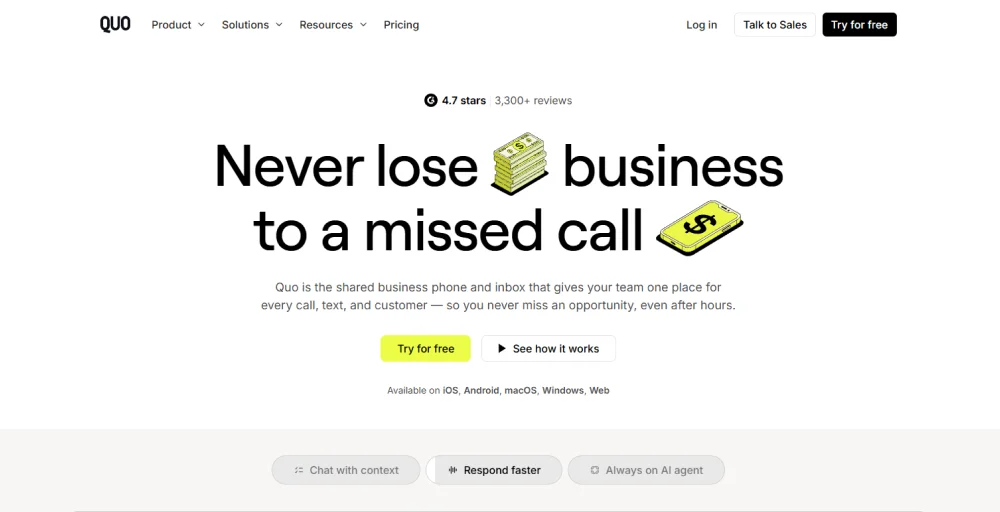
It moves away from the legacy feel of traditional VoIP by treating phone calls and texts more like a collaborative messaging app.
Core AI capabilities
- Sona AI voice agent: A sophisticated AI receptionist that handles missed calls 24/7, answering common questions and qualifying leads before they ever reach your team.
- QUO API: Provides the technical flexibility to connect your AI communication platform to custom internal tools or niche CRMs for advanced customer support automation.
- AI call tags: Automatically analyzes call transcripts to apply relevant tags (such as “Billing,” “Urgent,” or “Sales”).
- AI call notes & summaries: Generates concise, bulleted AI call summaries and extracts specific action items immediately after a call ends, ensuring nothing falls through the cracks.
- Voicemail transcription: Instantly convert voicemails into a readable text, letting teams scan and prioritize callbacks without listening to audio.
Unique advantage
Quo’s clearest strength is the combination of product simplicity and genuine AI utility. The Sona AI agent saves time, and it is the first business phone system to be listed in Anthropic’s Claude Connectors Directory.
Limitations
- AI call summaries are locked behind the Business plan at $23/user/month, as the Starter plan only generates summaries for Sona-handled calls, not regular conversations.
- Limited power dialing and no parallel dialing capability make Quo a poor fit for high-volume outbound sales teams.
Pricing breakdown
- Quo’s pricing and plan are built around a shared-inbox experience and their proprietary AI agent, Sona.
- Quo includes three primary subscription plans:
- Starter: $15/user/month (billed annually)
- Business: $23/user/month (billed annually)
- Scale: $35/user/month (billed annually)
- A 7-day free trial is available for new users to explore the platform’s interface and AI capabilities.
Best use case
Quo is the strongest pick for small businesses, freelancers, and startups that need a simple, modern replacement for personal phone numbers. It is the top choice for teams of 5–50 people who need a transparent, collaborative way to manage high volumes of calls and texts without losing the human touch.
G2 review
What users are saying
“Quo is a truly excellent app for both small and large businesses to stay connected with their customers around the world. What makes it outstanding is its support team, which helps ensure the app is always improving to meet your needs.”
10. Goodcall
Goodcall is an AI-powered phone system purpose-built for small, local service businesses. It functions as a 24/7 virtual receptionist, answers common questions, captures lead details, and handles basic appointment requests.

Unlike complex enterprise communication tools, Goodcall focuses on simplicity and speed, allowing a business to set up a professional AI phone answering service in minutes by syncing with their Google Business Profile.
Core AI capabilities
- AI voice agent: Handles calls 24/7, answers FAQs, captures caller information, and routes or escalates based on pre-configured logic.
- Automated lead capture: Uses Speech Recognition to extract names, phone numbers, and intents.
- Advanced knowledge base: Goodcall trains its AI agent on your website or Google Business Profile content.
- SMS follow-up automation: Automatically texts callers a booking link or a “thank you” message after the call ends, keeping the customer journey moving.
- Smart call routing: Employs Natural Language Processing to distinguish between routine inquiries and urgent requests, ensuring high-priority calls are routed to a human immediately.
Unique advantage
Goodcall’s most distinct feature is its Unique Customer pricing model. Most AI VoIP providers charge by the minute, which can lead to unpredictable bills. Goodcall allows for unlimited minutes per call; instead, you pay based on the number of unique people who call your business each month.
Limitations
- Goodcall does not currently support number porting.
- The unique-caller pricing model can become expensive for high-volume businesses. Once you exceed 100 unique monthly callers, the $ 0.50-per-caller overage adds up faster than per-minute alternatives at similar volumes.
Pricing breakdown
- Goodcall’s pricing is based on a unique caller model rather than traditional per-minute billing.
- Goodcall includes three primary subscription plans:
- Starter: $66/agent/month
- Growth: $108/agent/month
- Scale: $208/agent/month
Note: If a single customer calls 10 times in a month, they count as 1 unique customer. However, if you exceed your plan’s monthly limit, an overage fee of $0.50 per additional unique customer is applied.
Best use case
Goodcall is the right tool for solopreneurs and micro-businesses who need a simple, cost-effective way to ensure their phone is answered around the clock without hiring staff. It’s also a strong fit for local service businesses with high but predictable inbound call volume.
G2 review
What users are saying
“Their on-time Customer Services. Their numerous Features best part it is easy to use.”
Which AI phone system is best for you?
The honest answer for the best system for you is that it depends. The best AI phone system shifts based on how big your team is, what you can spend, what industry you’re in, and what you’re actually trying to accomplish.
Here is how to narrow down the best AI phone system based on your unique needs:
Based on team size
- Solo & small teams (1-10): Goodcall, KrispCall, & Allo
- Growing mid-market (11-100): KrispCall & Quo
- Large enterprise (100+): RingCentral & Dialpad
Based on the budget
- Most affordable: KrispCall, Dialpad, & Nextiva
- Mid-range value: CloudTalk, RingCentral & Allo
- Premium investment: Weave, Goodcall, & Aircall
Based on industry
- Healthcare & home services: Weave.
- E-commerce & global startups: Allo & KrispCall
- Professional services (Law/Finance): RingCentral & Nextiva
- Restaurants, salons & local service businesses: Goodcall
Based on goals (sales vs support)
- Sales acceleration (Outbound): CloudTalk & Dialpad
- Superior Support (Inbound): Aircall & Quo
- Customer support & helpdesk efficiency: KrispCall
What are the benefits of AI phone systems for businesses?
Here are some of the benefits of an AI phone system for businesses:
24/7 availability
AI phone systems use AI receptionists and virtual assistants to ensure your business never truly closes. According to LiveChat AI’s 2025 customer dataset, 65% of incoming support queries were resolved without human intervention, up from 52% two years earlier. For small businesses and local service providers, 24/7 service availability is the fastest way to stop losing customers to competitors.
Cost reduction
Human-led support is one of the highest overheads for any business. AI-powered telecom management can help enterprises achieve 33-40% cost reduction compared to just 20% with manual or software-only approaches. According to Gartner, conversational AI is projected to save $80 billion in contact center labor costs by 2026, not by eliminating agents, but by handling the volume that would otherwise overwhelm them.
Productivity boost
Every minute a rep spends manually logging a call, writing up notes, or listening back to a recording is a minute not spent selling or solving problems. AI removes that friction at scale. Studies suggest that support agents using AI tools handle 13.8% more customer inquiries per hour, and service professionals save over 2 hours daily using generative AI for quick responses.
Better lead conversion
Speed is the single biggest variable in lead conversion, and AI closes the gap between interest and contact faster than any human team can. AI has reduced first-response times across industries from over 6 hours to less than 4 minutes and resolution times from 32 hours to 32 minutes, an 87% improvement.
Improved customer experience
Modern customers value speed and resolution over small talk. AI delivers both by providing instant answers and reducing hold times. Among executives who report productivity gains from AI deployment, 39% have seen productivity at least double, with 74% reporting ROI within the first year of deploying AI agents in production.
How much ROI can you expect from AI phone systems?
ROI from an AI phone system compounds across several parts of the business simultaneously. Here is the breakdown of where that ROI actually comes from:
Cost per call reduction
The most immediate impact is the dramatic drop in operational overhead. While a human-handled call typically costs between $7.00 and $12.00, a voice AI interaction now costs roughly $0.40. By automating routine inquiries, which account for nearly 80% of total call volume, enterprises are projected to save a combined $80 billion in labor costs this year alone.
Conversion rate increase
The fastest way to improve conversion rates is to respond faster. By using AI SMS follow-ups and instant routing, businesses can hit the Golden Window, responding to a lead within the first minute. This immediate engagement has been shown to increase lead conversion rates by over 391%, turning missed calls into closed deals before the prospect can contact a competitor.
Time saved per employee
AI removes the hidden administrative burden that kills daily productivity. By automating call transcription, summary generation, and CRM data entry, the employee saves roughly 2 hours per day. This shift allows staff to pivot from repetitive data entry to high-value strategic work.
Revenue impact
Beyond simple savings, AI also creates new money-making opportunities. Integrated sentiment analysis and Next-Best-Action prompts help agents identify upselling opportunities during live support calls. On average, businesses using AI-driven strategies or insights report a 15–25% increase in revenue per customer, as the system identifies cross-selling triggers that a human agent might otherwise miss in the heat of the moment.
What are the key features to look for in an AI phone system?
Selecting the right intelligent business calling platform requires looking beyond basic dial tones to find the features that matter most. Here’s what to prioritize:
AI answering
Your phone system’s first job is to make sure no call goes unanswered.
Look for a platform that handles inbound calls using natural language processing rather than rigid “press 1, press 2” menus. A capable AI answering service should qualify leads, handle FAQs, take messages, and hand off complex queries to a live agent without the caller feeling like they’ve hit a dead end. If the AI can’t manage a basic inbound flow convincingly, no other feature on the list matters.
Transcription
Transcription is the foundation on which everything else is built. Without it, there’s no summary, no coaching data, and no CRM sync worth having.
Look for platforms that offer real-time call transcription, not just post-call processing. Then check how accuracy holds up in real conditions, such as noisy environments, fast talkers, and heavy accents. A transcript that’s 70% accurate creates more confusion than clarity.
Call summaries
A full call transcript is useful. A sharp, automatically generated summary is what your team will actually use.
Prioritize systems that use machine learning to extract action items, key discussion points, and next steps immediately after a call ends. Then push them directly into your CRM without anyone touching a keyboard.
Sentiment analysis
The best AI phone systems don’t just record what was said, but also track how it felt.
Sentiment analysis monitors emotional tone throughout a call, flagging frustration, hesitation, or buying intent in real time. This lets managers jump into escalating situations before they turn into lost deals or churned customers. It turns call data into coaching data, which is where the real performance gains live.
CRM automation
A phone system that doesn’t sync with your CRM doesn’t save time; it just moves manual work elsewhere.
Your AI business phone system should automatically push call logs, recordings, transcripts, and summaries into platforms like HubSpot or Salesforce the moment a call ends. If native integration isn’t available and the workflow depends on Zapier for basic logging, that gap compounds every single day across your entire team.
Dialers
For sales teams, the dialer is where productivity is made or lost, and not all dialers are equal.
A power dialer moves through a call list automatically, cutting dead time between conversations. A parallel dialer goes further, ringing multiple lines simultaneously and routing only live answers to the rep. For outbound teams with connect rates below 10%, the right dialer saves time and multiplies the number of live conversations reps have each day.
How do AI phone systems help businesses increase sales and optimize support & operations?
Here are five ways AI phone systems optimize your business operations:
1. 24/7 Customer support without expanding your team
An AI answering service acts as a permanent front-desk layer or a virtual receptionist. Instead of sending customers to voicemail after hours, the system engages them in real time using conversational AI, captures the information that matters, and escalates to a human when the situation calls for it.
Common use cases:
- Providing 24/7 after-hours coverage without hiring night-shift staff.
- Automatically capturing support tickets and qualifying leads.
- Answering repetitive questions about hours, pricing, and availability instantly.
2. High-velocity lead conversion
AI eliminates the speed-to-lead gap by ensuring every prospect is engaged the moment they call. With smart dialers and automated SMS follow-ups, the system prioritizes the most promising leads and ensures your sales team is the first to respond.
Common use cases:
- Sending an instant “Sorry we missed you” text with a booking link if a call isn’t answered.
- Using predictive dialers to connect sales reps only when a live human picks up.
- Routing VIP prospects to senior account executives based on CRM data.
3. Automated post-call documentation
One of the biggest productivity killers is manual data entry. AI phone systems use call transcription and AI call summaries to automatically log the details of every conversation. This ensures your CRM is always accurate and your team spends their time talking, not typing.
Common use cases:
- Syncing call recaps directly to CRMs or helpdesk tools.
- Automatically extracting “Action Items” and adding them to a rep’s to-do list.
- Creating searchable archives of customer conversations for future reference.
4. Real-time coaching and quality assurance
Managers no longer need to “listen in” on every call to ensure quality. Sentiment analysis and call scoring AI monitor 100% of conversations, flagging frustrated customers or identifying top-performing sales scripts that the rest of the team should adopt.
Common use cases:
- Alerting a supervisor to jump into a call if the AI detects high customer frustration.
- Identifying common objections in sales calls to update the team’s training manual.
- Automating performance reviews by scoring agents on their adherence to scripts.
5. Seamless omnichannel context
AI phone systems bridge the gap between different communication silos. By integrating with your existing tools, the system provides a 360-degree view of the customer, ensuring the agent has the full context of their journey.
Common use cases:
- Display a Call Pop with the customer’s last order and support ticket when they call.
- Connecting a caller to the same agent they spoke with previously for better continuity.
- Analyzing customer sentiment across all platforms to predict and prevent churn.
How AI phone systems handle security & compliance?
Here is how AI phone systems handle your most critical security concerns:
GDPR
Under the General Data Protection Regulation (GDPR), voice data and biometric data are treated as special category data. AI systems manage this through automated workflows:
- AI systems automate consent management, playing legal disclosures before recording.
- They also offer “Right to Erasure” tools that purge audio, transcripts, and AI summaries across all synced CRMs with a single click to meet global privacy standards.
Data encryption
To protect against breaches, AI phone systems use the same level of security as global banking institutions:
- All data is encrypted at rest with AES-256 and in transit with TLS 1.3.
- Top-tier providers now utilize Quantum-Resistant algorithms, ensuring your voice data remains unreadable to unauthorized parties both now and in the future.
Call recording policies
Recording laws vary wildly (one-party vs. all-party consent). AI phone systems eliminate the legal guesswork by automating compliance based on geography:
- AI automatically detects the caller’s location and applies local “one-party” or “all-party” consent rules.
- PII Redaction uses NLP to identify and “black out” sensitive information, such as credit card numbers, from both audio and transcripts to ensure full compliance.
Why KrispCall stands out as the best AI phone system for business growth?
KrispCall has established itself as an AI-powered cloud telephony leader by focusing on a single goal: removing friction for international business growth.
Here is why KrispCall is the premier choice for businesses looking to scale:
The Unified Callbox: A 360-degree communication hub
KrispCall’s standout feature is its Unified Callbox, which consolidates all customer interactions into a single, shared dashboard. This eliminated communication silos, ensuring that every team member has the exact same context on a customer’s journey, regardless of where they are.
AI Copilot: Smarter messaging and faster responses
The AI Copilot acts as a virtual assistant for your frontline staff. It uses Natural Language Processing to help agents:
- AI rephrasing: Instantly polish text messages and replies for clarity and professional tone.
- AI reply: Automatically generate responses to common customer inquiries.
- AI transcription & summaries: Automatically converts the recording into searchable text and extracts key action items
Global expansion with instant local presence
KrispCall is the best AI phone system for international growth because it offers virtual numbers in 100+ countries. Businesses can establish a local presence in any market without expensive carrier contracts or physical office requirements.
Advanced outbound efficiency (Power Dialer)
For sales-driven organizations, KrispCall’s Power Dialer is a game-changer. It automates the dialing process from a pre-set list, skipping busy signals and unanswered calls to ensure reps are only talking to live prospects.
Seamless workflow automation & 100+ integrations
KrispCall integrates natively with HubSpot, Salesforce, Pipedrive, Bitrix24, and 100+ other platforms. Every conversation is automatically logged with full context, so reps always pick up where the last interaction left off. Set up custom triggers and automate your workflows.
Live AI coaching & monitoring
KrispCall allows managers to move from reactive to proactive coaching. With Live Call Monitoring and AI Coaching tools, supervisors can listen to live calls and provide verbal advice to agents (whispering) so the customer doesn’t hear, ensuring high-stakes conversations are handled with expert precision.