

Talkroute remains a reliable virtual business phone system for small business owners, but many businesses now need more advanced features. Businesses expect AI capabilities, shared inboxes, CRM integrations, and simpler collaboration features that Talkroute does not fully support.
Modern alternatives now deliver easier setup, stronger automation, better scalability, and more flexible communication tools for solopreneurs, startups, and growing remote teams.
The best alternatives to Talkroute
- KrispCall: Best for startups, remote teams, and businesses needing affordable international calling with collaborative team features.
- Dialpad: Best for sales and support teams that want AI-powered calling, automation, and analytics.
- Quo: Best for small and mid-sized teams that rely on shared phone numbers and collaborative messaging.
- RingCentral: Best for enterprises and multi-location businesses needing advanced integrations and scalability.
- Nextiva: Best for growing businesses that prioritize uptime, customer experience and advanced call management.
- Google Voice: Best for freelancers and Google Workspace users seeking a simple, affordable business phone solution.
- Unitel Voice: Best for solopreneurs and startups seeking an easy setup with predictable, flat-rate pricing.
- Grasshopper: Best for small businesses that want professional calling features on personal devices.
- Vonage: Best for SMBs needing reliable communication, flexible customization, and CRM integrations.
- Phone.com: Best for healthcare professionals and small businesses requiring HIPAA-compliant communication tools.
How did we select the top Talkroute alternatives?
We have selected the top Talkroute alternatives by evaluating how well competing virtual phone systems address Talkroute’s core limitations, specifically in modern collaboration, pricing, and advanced technology.
- Collaboration Capabilities: Talkroute primarily routes calls to individual cell phones or landlines. Top alternatives are selected based on their ability to offer shared team inboxes where multiple employees can view, text, and respond to the same number collectively.
- Advance AI Features: While Talkroute lacks deep productivity automation, alternative options are heavily weighted for their AI-generated call summaries, live sentiment analysis, and automated voicemail transcriptions.
- Integrations: Evaluations prioritize software that includes native CRM integrations. Talkroute remains relatively isolated from external productivity tech stacks.
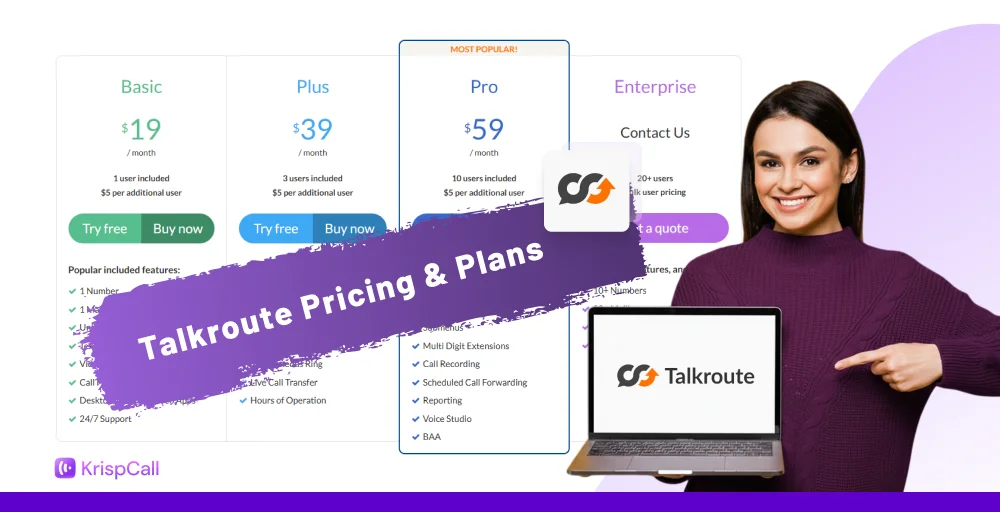
- Pricing: Talkroute entry pricing ($19/month) covers only a single user and lacks essentials such as call recording or an auto-attendant.
- App usability: Selections are favored if they provide streamlined, intuitive desktop and mobile app experiences with a modern interface, rather than Talkroute’s more old-school, legacy-style layout.
10 best Talkroute alternatives comparison
Talkroute is a reliable virtual phone system for small to medium businesses focused on standard call routing, extensions, and custom menus. However, as businesses seek advanced collaboration, native CRM integrations, and AI features, they often look for alternatives.
| Provider | Starting Price | Best For | Standout Features | G2 Review |
| KrispCall | $12/user/month | Startups, remote teams, and global businesses | Unified Callbox, CRM integrations, international numbers, AI call summaries | 4.5/5⭐ |
| Dialpad | $15/user/month | AI-powered sales and support teams | Real-time AI transcriptions, omnichannel support, AI scorecards | 4.4/5⭐ |
| Quo | $15/user/month | Collaborative customer communication | Shared inboxes, AI call transcripts, ring groups | 4.7/5⭐ |
| RingCentral | $20/user/month | Large enterprises and multi-location teams | 330+ integrations, video meetings, AI-powered analytics | 4.1/5⭐ |
| Nextiva | $15/user/month | Growing customer support and operations teams | Advanced call management, analytics, and VoIP switchboard | 4.5/5⭐ |
| Google Voice | $10/user/month | Google Workspace users and freelancers | Gmail integration, spam filtering, simple VoIP setup | 4.1/5⭐ |
| Unitel Voice | $9.99/month | Solopreneurs and small startups | Free custom greetings, virtual PBX, simultaneous ring | 4.6/5⭐ |
| Grasshopper | $14/month | Small businesses using personal devices | VoIP/Wi-Fi calling, call blasting, customized extensions | 3.9/5⭐ |
| Vonage | $13.99/user/month | SMBs need reliable communication | AI virtual assistant, video meetings, CRM integrations | 4.3/5⭐ |
| Phone.com | $15/user/month | Healthcare professionals and micro-businesses | HIPAA compliance, custom routing, call logs | 3.4/5⭐ |
1. KrispCall
Best for: Startups, small remote teams, growing sales or support departments that require low-cost international calling combined with shared workspace features.
We find that KrispCall is a highly capable, modern cloud phone system designed to eliminate the silos created by traditional call forwarding. It bridges the gap between affordable virtual communication and collaborative customer management.
KrispCall centers its platform around “Unified Callbox”, which brings all phone calls, text messages, voicemails, and team chats into a single centralized screen. This helps teams manage customer conversations, connect callers with the right person, and improve overall customer satisfaction.
How it solves Talkroute’s limitations
- Shared Team Inbox: Combines calls, SMS, and voicemails into one collaborative workspace for the entire team.
- CRM Integrations: Syncs automatically with tools such as HubSpot and Zendesk to keep customer records up to date.
- Global Coverage: Offers virtual phone numbers in 100+ countries for affordable international business communication.
KrispCall pricing
Here, we have breakdown KrispCall pricing based on annual billing:
| Plan | Annual price (per user/month) | Key feature set |
| Essential | $12 | 1 free US/UK/Canada number, calling/SMS, Unified Callbox |
| Standard | $32 | Call recording, Multi-level IVR, CRM integrations, Advanced routing |
| Custom | Custom pricing | Power dialer, Live monitoring tools, Custom APIs |
KrispCall standout features
- Unified callbox: Merges calls, SMS, and voicemails into one clean feed.
- Live coaching: Allow managers to monitor, whisper, or barge into active customer calls.
- Multi-level IVR: Provides customizable features and automated phone trees that instantly route callers to the correct department.
- Custom caller ID: Ensures you always display the right number for your target customer, building trust.
- Call transcription & summaries: Automatically transcribes and summarizes recorded calls to help teams save time and improve productivity.
KrispCall pros
- KrispCall provides virtual phone numbers and local presence in over 100 countries.
- Doesn’t charge for per-recording or storage limits.
- Eliminates the need for expensive on-premise hardware and reduces setup and maintenance costs.
KrispCall cons
- Core integrations and call recording require an upgrade to a mid-tier plan.
- International activation requires strict regulatory document approvals.
- Occasional minor software glitches reported during heavy outbound usage.
What user say about KrispCall
Evan C. Reservation Agent Small-Business (50 or fewer emp.) (G2)
Country number provisioning is instant. Bulk SMS for campaign follow-ups was a bonus feature we now use daily. Call quality to the UK is crisp.
Laurel I. Product Analyst Small-Business (50 or fewer emp.) (G2)
International calling rates are way cheaper than our old provider, voicemail transcriptions are surprisingly accurate.
2. Dialpad
Best for: Sales organizations, customer support teams, fast-growing businesses that require heavy outbound calling and deep AI-driven automation to track and optimize conversations.

Dialpad is an AI-powered, cloud-based business communication platform that unifies business phone, video meetings, team messaging, and customer support into a single workspace. Built directly on a modern global cloud infrastructure, it bypasses traditional phone systems to deliver exceptionally clear call quality and automatic scaling for businesses of all sizes.
The system stands out in the VoIP market by natively integrating deep, proprietary artificial intelligence into every layer of the platform, rather than treating AI as a high costs third-party add-on.
How it solves Talkroute’s limitations
- AI Automation: Provides real-time call transcriptions, summaries, and AI-powered coaching tools.
- Workflow Integrations: Connects with Salesforce, HubSpot, and Google Workspace for seamless productivity.
- Unified Communication: Combines calling, messaging, and video conferencing in one platform.
Dialpad pricing
Dialpad pricing breakdowns following the three pricing plans:
| Plan | Annual price (per user/month) | Key feature set |
| Standard | $15 | Unlimited calling, Visual voicemail, Three-way calling |
| Pro | $25 | Number forwarding, Audio chat rooms, Real-time call transcriptions |
| Enterprise | Talk to sales | Extensions, File sharing, Virtual backgrounds |
Dialpad standout features
- Omnichannel support: Packages digital team text messages, high-definition video meetings, and phone calls into one environment.
- AI Scorecards: Automates agent call evaluation against customizable quality assurance metrics and criteria using a built-in AI engine.
- HD conference calls: Delivers clear, high-definition, browser-based audio and video calling with integrated screen sharing and in-meeting chat.
- Voicemail drop: Let outbound sales reps leave a pre-recorded message instantly at the click of a button when they hit a prospect’s voicemail.
- Call park: Places an active inbound call on hold in a communal “parking lot” so any available team member can retrieve it from another extension.
Dialpad pros
- Industry-leading AI tools are included natively right at the entry-level price tier.
- Call audio quality and reliable cloud network uptime.
- Offers deep stable integrations with major enterprise business apps.
Dialpad cons
- Advanced CRM syncing and international operations are locked behind the mid-tier Pro plan.
- Pro plan enforces a strict minimum of 3 users.
- Advanced setup and call routing paths can be overwhelming for simple users.
3. Quo
Best for: Small- to medium-sized businesses, remote or hybrid customer service teams that need a highly collaborative workspace where multiple people can seamlessly manage the same phone lines.

Quo is a cloud-based VoIP business phone system tailored for growing teams that need highly collaborative communication tools, rather than just basic call routing. It shifts business phone systems from individual accounts into a shared, transparent inbox where teams can tag each other on calls, notes, and messages.
The platform features a highly intuitive user experience alongside its signature “Sona AI” receptionist to help businesses automate operations.
How it solves Talkroute’s limitations
- Collaborative Inbox: Allows multiple team members to manage the same business number together.
- Shared Conversations: Keeps calls, texts, and voicemails organized in a single conversation with internal threads.
- AI Productivity Tools: Includes voicemail transcripts and searchable call records for faster follow-ups.
Quo pricing
Quo offers the following three pricing plans:
| Plan | Annual price (per user/month) | Key feature set |
| Starter | $15 | Voicemail transcripts, Quo API, Email ticket support |
| Business | $23 | Group calling, Phone menus. Call transfers |
| Scale | $35 | Inbound phone support, Dedicated onboarding support, AI call tags |
Quo’s standout features
- Call forwarding: Route calls to teammates, external numbers, or voicemail when unavailable.
- Voicemail to text: Get voicemail transcripts directly in your inbox for faster response.
- Call transcriptions: Access AI-generated call transcripts and searchable records.
- Ring groups: Route calls to specific teams simultaneously or sequentially.
- Three-way calling: Add participants to live calls and record conversations with summaries and transcripts.
Quo pros
- It has a modern user-friendly interface that requires zero employee onboarding time.
- Includes unlimited calling, text messaging, and call recording right on the affordable base tier.
- Separate professional phone numbers clearly from personal ones across mobile and desktop devices.
Quo cons
- Key CRM-native syncs and advanced AI workflows are locked behind higher-tier plans.
- There are occasional reports of inconsistent accuracy in AI audio transcriptions.
- Lacks the extensive, heavy-duty hardware desk phone compatibility found in complex enterprise setups.
4. RingCentral
Best for: Mid-market companies, large enterprises, and multi-location businesses need a scalable unified communications platform that supports VoIP, video conferencing, & desk phones.
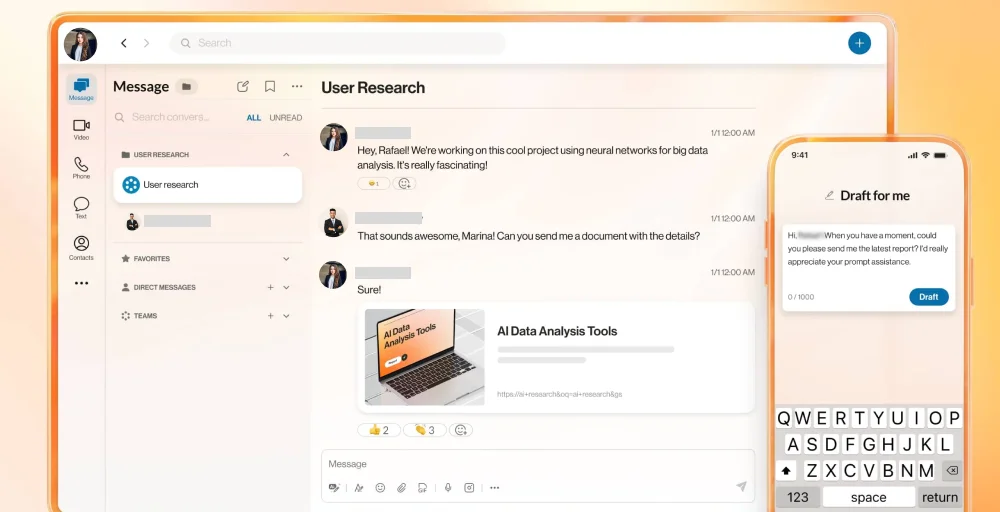
RingCentral is a powerful communication platform in the unified communications (UCaaS) sector. The platform combines enterprise-grade VoIP, messaging, video meetings, analytics, and integrations that integrate seamlessly with CRM and productivity tools.
Operating with a guaranteed 99.999% financially backed uptime SLA, it is engineered for organizations where missing a single phone call translates into massive revenue loss. The platform is heavily focused on productivity, utilizing RingSense AI to automatically generate real-time call transcriptions, notes, and action items for your team.
How it solves Talkroute’s limitations
- Enterprise Infrastructure: Delivers a complete cloud PBX system instead of basic call forwarding.
- Extensive Integrations: Supports 330+ integrations with major business applications.
- Advanced Collaboration: Includes AI summaries, analytics, messaging, and video conferencing tools.
RingCentral pricing
RingCentral structures its core RingEX platform across three distinct per-user, per-month tiers.
| Plan | Annual price (per user/month) | Key feature set |
| Core | $20 | Unlimited domestic calling, Appointment booking, Notes & summaries |
| Advanced | $25 | 10, 000 toll-free minutes, AI Virtual Assistant, Captions & transcriptions |
| Ultra | $35 | 200 SMS user/month, Device analytics & alerts, RingCentral Webinar |
RingCentral standout features
- Automatic call recording: Automatically records inbound and outbound calls for specific users or departments.
- Business SMS: Send and receive text messages, images, and audio files directly from your business or professional number across mobile and desktop devices.
- RingOut: Instantly connects calls via any phone or internet-connected computer, letting you make outbound calls while masking your personal cell phone number.
- Answering rules: Customizable call routing that sends calls to different destinations based on specific schedules, holidays, or caller ID.
- Shared lines: Allows a single business phone number to be shared across multiple desk phones.
RingCentral pros
- Compatibility with major physical IP desk phones, headsets, and overhead paging systems.
- Allows you to mask your personal cell phone number during business calls via smartphone.
- Offers unlimited domestic calling, intelligent IVR, video conferencing, feature rich plans.
RingCentral cons
- Restricted monthly SMS caps on basic tiers that require extensive booster extra add-ons.
- Base pricing makes it excessive for teams of fewer than 20 people.
- Large implementations or advanced contact center configurations require custom quotes.
5. Nextiva
Best for: Growing mid-sized businesses and customer-facing teams that require an enterprise-grade, all-in-one platform combining VoIP phone services, video collaboration, and built-in CRM capabilities.

Nextiva is a cloud-based unified communications platform that serves as a high-powered alternative to basic forwarding services. It consolidates voice calling, team messaging, video conferencing, faxing, and customer relationship management into a single dashboard.
Backed by highly reliable data centers and 24/7 customer support, Nextiva is built to scale a company’s entire communication infrastructure from a small office to a full-scale corporate call center.
How it solves Talkroute’s limitations
- Advanced Call Management: Adds supervisor controls, call monitoring, and analytics features.
- All-in-One Platform: Combines VoIP, CRM, messaging, and video collaboration in one dashboard.
- Automation Features: Automatically tracks customer interactions across integrated systems.
Nextiva pricing
Nextiva structures its pricing on a per-user, per-month basis based on volume and contract length.
| Plan | Annual price (per user/month) | Key feature set |
| Core | $15 | Auto-attendants, call menus, Team messaging |
| Engage | $25 | Video calls, screen sharing, Online fax, Chatbot |
| Scale | $75 | Unlimited text message, Live Chat, Built-in call center |
Nextiva’s standout features
- Call screening: Displays caller details instantly and lets you automatically block spam or route specific numbers to voicemail.
- Advance call management: uses multi-level auto-attendants, call queues, and ring groups to direct high volumes of incoming callers efficiently.
- VoIP switchboard: A visual dashboard allows operators to track live team presence and seamlessly transfer, park, or flip active calls.
- Call analytics: Real-time reports monitor call volumes, wait times, and staff performance to help optimize your business operations.
- SIP trunking: This service connects your existing on-premise hardware to the cloud for cheaper, scalable, and highly reliable communication.
Nextiva pros
- Guarantees a 99.999% network uptime to prevent dropped calls.
- Provides an incredibly easy drag-and-drop flow builder to customize automated call trees.
- Delivers high-quality reporting metrics on team performance & customer volume.
Nextiva cons
- The administrative dashboard can be confusing and carries a steep learning curve.
- Video conferencing has a limited number of participants.
- Need expert support for setting up complex department shifts or custom integrations
6. Google Voice
Best for: First-time entrepreneurs, freelancers, and small teams already using Google Workspace who need a cheap, straightforward second phone line.

Google Voice for Google Workspace is a cloud-based phone service designed to seamlessly blend into Google’s ecosystem. It provides users with a dedicated business phone number that can be accessed via a mobile app, a web browser, or compatible desk phones.
Because it is built entirely on Google’s infrastructure, it integrates natively with Google Meet and Google Calendar, Microsoft Teams integrations, making it an incredibly lightweight and intuitive communication tool for modern, cloud-first teams.
How it solves Talkroute’s limitations
- Reliable VoIP Calling: Runs on Google’s cloud infrastructure for stable call quality.
- Google Workspace Integration: Works seamlessly with Gmail, Calendar, and Google Meet.
- Simplified Communication: Centralizes business communication within the Google ecosystem.
Google Voice pricing
Google Voice requires an active paid Google Workspace subscription (starting at $6/user/mo) and offers three flat-rate, per-user pricing tiers:
| Plan | Annual price (per user/month) | Key feature set |
| Starter | $6.30 | Shared calendars, forms survey builder, 2-step verification |
| Standard | $12.60 | Adaptive Audio, Hand raising, Polling, and QA |
| Plus | $22 | Auto-accept invitations, In-domain live streaming, Attendance tracking |
Google Voice standout features
- Adaptive Audio: Merges audio from laptop microphones in the same room to eliminate echo.
- Keep shared notes: Allows multiple users to view and edit lists simultaneously.
- Attendance tracking: Sends a report to meeting hosts detailing who joined.
- One-to-one external chat: Lets users send secure direct messages to outside contacts.
- Data loss prevention (DLP): Blocks users from sharing sensitive company data externally.
Google Voice pros
- It natively integrates with Gmail, Google Calendar, and Google Contacts.
- You can easily port your existing cell phone or landline number to Google Voice.
- It automatically filters out suspected spam calls.
Google Voice cons
- This requires a paid Workspace add-on license.
- No toll-free number options available.
- Offers minimal CRM integrations with third-party software.
7. Unitel Voice
Best for: Solo entrepreneurs, startups, and micro-teams looking for a dead-simple, ultra-affordable virtual phone system with high-quality, US-based human customer support.

Unitel Voice is a virtual phone system built specifically for small business builders. It provides essential professional features, like auto-attendants, custom greetings, and call scheduling, without the complexity or expanding of enterprise systems.
Operating primarily through a mobile app and softphone setup, it helps entrepreneurs project a big-company professional image directly from their personal smartphones.
How it solves Talkroute’s limitations
- Predictable Pricing: Offers flat-rate plans without costly per-user add-ons.
- Easy Setup: Enables businesses to launch quickly using existing devices.
- Virtual Receptionist: Includes automated greetings, scheduling, and call routing tools.
Unitel Voice pricing
Unitel Voice structures offer transparent pricing plans around the scale of your business needs:
| Plan | Monthly | Key feature set |
| Startup | $9.99 | 3 Users, 1 Phone Number, 500 Monthly Minutes |
| Unlimited | $24.99 | Unlimited users, Mobile app, unlimited minutes |
| Office | $29.99 | Desktop softphone, team messaging, desk phones |
| Office-Max | $69.99 | 10 users, presence indicator, mobile app |
Unitel Voice standout features
- Second phone line: It adds a separate business number to your personal device so you can cleanly isolate work calls and messages.
- Custom greetings: The service provides free professional voice talent to record your greetings, giving your business an enterprise-grade image.
- Simultaneous ring: It alerts multiple team members and devices at the exact same moment to minimize client wait times.
- Virtual PBX: This cloud-based system replaces physical office hardware with an automated receptionist that routes callers to specific extensions.
- Call scheduling: It automatically routes after-hours calls straight to voicemail to protect your personal work-life balance.
Unitel Voice pros
- This offers professional actors to record your greetings for free.
- Within seconds, you can add a new department or employees.
- The cloud setup works entirely on existing personal devices
Unitel Voice cons
- No permanent free version.
- Base plans struct limits on monthly talk minutes.
- It lacks deep native connections with platforms like Google Workspace.
8. Grasshopper
Best for: Small teams needing an established business image on existing personal cell phones.

Grasshopper functions as a virtual phone overlay that adds professional business capabilities directly onto your existing personal smartphones. Eliminating the need for expensive physical desk phones, headsets, or complex office wiring.
It centralizes all your basic features, professional texts, voicemail recordings, and inbound call center histories inside a single user-friendly mobile or desktop application to keep your brand organized. This allows small operations to present a highly polished, enterprise-grade image to the public while working remotely from anywhere.
How it solves Talkroute’s limitations
- User-Friendly Apps: Provide a cleaner, more intuitive mobile experience.
- Built-In Business SMS: Includes texting and calling features without requiring upgrades.
- Unlimited Users: Supports multiple team members without increasing monthly costs.
Grasshopper pricing
Grasshopper utilizes a predictable flat-rate billing model that charges businesses based on the number of phone lines they require rather than penalizing growth with per-user fees.
| Plan | Annual price (per user/month) | Key feature set |
| True Solo | $14 / month | 1 Phone Number, 1 Extension, Unlimited Users |
| Solo Plus | $25 / month | 1 Phone Number, 3 Extensions, Unlimited Users |
| Small Business | $55 / month | 4 Phone Numbers, Unlimited Extensions, Unlimited Users |
Grasshopper standout features
- Customized extensions: Forwards calls to specific team members or departments by creating unique numeric codes for your single main business line.
- VoIP/Wi-Fi calling: Uses your internet connection to make calls when cellular signals are weak, ensuring you never miss a client.
- Conversation filters: Organizes your communication history by separating business calls, texts, and voicemails from your personal smartphone notifications.
- Incoming call control: Identifies business calls instantly and lets you choose whether to accept them, send them to voicemail, or listen to screen notifications.
- Call blasting: Rings up to 15 employee phones simultaneously, so inbound sales prospects are answered as quickly as possible.
Grasshopper pros
- Works perfectly on existing mobile devices without requiring expensive IP desk phones.
- Keeps monthly billing predictable because plans allow an unlimited number of platform users.
- Uses toll-free and custom vanity numbers to give small startups an enterprise-grade appearance.
Grasshopper cons
- Lacks core enterprise tools like native video conferencing, call queues, or call recording.
- Costs significantly more than basic budget alternatives for individuals needing just one line.
- Restricts business phone number selections to the United States and Canada.
9. Vonage
Best for: Growing small-to-medium businesses (SMBs) and sales teams that require a highly reliable, customizable communication system with deep CRM integrations.

Vonage Business Communications is an industry-staple unified communications platform offering voice, team messaging, and video collaboration. Known for its exceptional 99.999% uptime reliability and clean, intuitive user interface, it operates on a modular ecosystem.
Instead of forcing businesses into bloated, expensive tiers, Vonage allows users to start with a strong baseline of essential communication tools and pick and choose specialized advanced add-ons as their business expands.
How it solves Talkroute’s limitations
- Hardware Compatibility: Supports desk phones and advanced office communication hardware.
- Video Collaboration: Includes built-in video meetings and team messaging tools.
- Customizable Workflows: Offers CRM integrations and advanced automation capabilities.
Vonage pricing
Vonage structures its pricing tiers per user, per month, based on volume (larger teams receive lower per-user rates):
| Plan | Annual price (per user/month) | Key feature set |
| Mobile | $13.99 | SMS and MMS, Phone number porting, VBC desktop app |
| Premium | $20.99 | Single sign-on, Vonage meetings, Team messaging |
| Advanced | $27.99 | Visual voicemail, call groups, on demand call recording |
Check out 👉: Vonage Pricing & Plans: The Complete Breakdown in 2026
Vonage’s standout features
- AI virtual assistant: Uses smart natural language processing to converse, book clients, and route calls.
- Call queue: Places incoming callers in an orderly line with music until agents free up.
- IP phone paging system: Broadcasts live voice announcements simultaneously over hundreds of office desk phone speakers.
- Virtual mailbox: Secures voicemail recordings online and sends text transcripts straight to your email.
- Call hold: Pauses active lines securely, allowing you to consult with teammates or flip devices.
Vonage pros
- Integrates with over 20 third-party platforms like Salesforce, HubSpot, and Slack.
- Guarantees incredibly high enterprise-grade reliability through a robust, global cloud infrastructure.
- Handles SMS, MMS, video meetings, and team chats in one unified dashboard.
Vonage cons
- Premium tools like call recording and AI assistants require pricey monthly upgrades.
- Entry-tier pricing is higher than that of budget rivals like Google Voice and Unitel.
- Long-term commitments are often required to secure their lowest advertised monthly rates.
10. Phone.com
Best for: Healthcare professionals, solopreneurs, and micro-businesses who need a budget-friendly, HIPAA-compliant communication system.
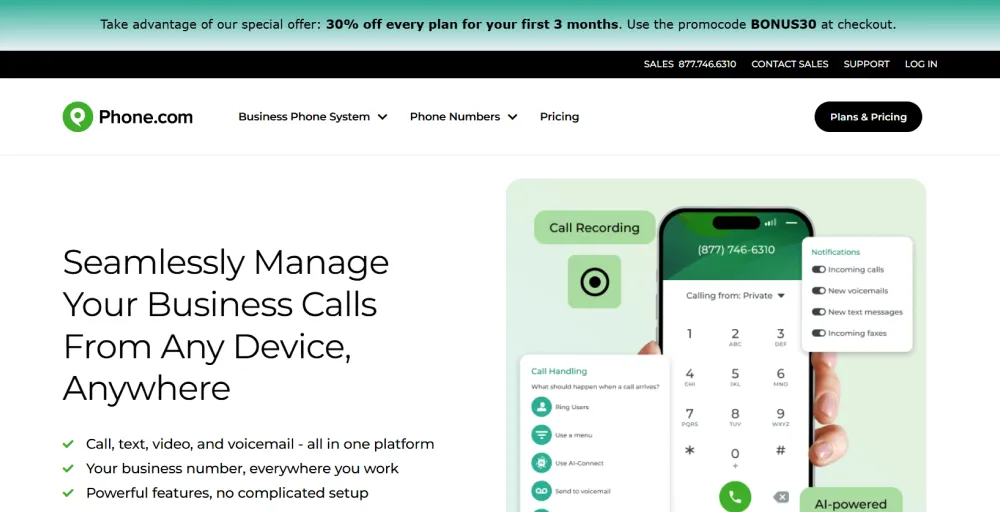
Phone.com is a highly customizable cloud-based virtual phone system designed specifically for small businesses. It stands out by offering standard modern PBX capabilities, like auto-attendants, call routing, and video conferencing, without forcing users into expensive, rigid contracts.
Unlike modern app-only platforms, Phone.com supports IP desk phones, softphones, and mobile apps, giving teams access to a professional setup regardless of their preferred hardware.
How it solves Talkroute’s limitations
- HIPAA Compliance: Supports secure communication for healthcare and regulated industries.
- Flexible Call Routing: Provides customizable routing, greetings, and video conferencing.
- Mixed User Plans: Let businesses combine different plan types to reduce costs.
Phone.com pricing
Phone.com structures its tiers per user, per month (with discounts available for annual billing):
| Plan | Annual price (per user/month) | Key feature set |
| Basic | $15 | Greetings, call logs, hold music, video recording |
| Plus | $22.50 | One additional number per user, IP desk phone, and AI-powered call routing |
| Pro | $33.33 | 10-year data retention, call analytics, CRM integration |
Phone.com standout features
- Call logs and recordings: Allows you to track and download detailed call logs (duration, caller ID, mobile carrier) directly to CSV.
- Hold music: Custom hold music and professional greetings are fully supported.
- Custom call routing: Manage where calls go using customizable business-hour schedules and multi-level automated attendants.
- Voice tagging: Use custom call tags to easily identify the origin of incoming calls.
- Security confidence: Highly secure and is designed to support HIPAA compliance.
Phone.com pros
- Easy to add professional voice talent audio.
- Offers BAAs for secure medical communications.
- Mix unlimited and metered user plans freely.
Phone.com cons
- Video meeting restricts participant counts heavily.
- Lacks deep CRM connections on lower tiers.
- SMS limits apply to entry-level accounts.
Which Talkroute alternative is best for you?
Choosing the right Talkroute alternative depends on your business size, communication needs, budget, and workflow priorities. To find the best fit, see which scenario matches your business:
- If your team needs affordable international calling with strong collaboration tools, go with KrispCall. Shared inboxes, global virtual numbers in 100+ countries, and CRM integrations make it ideal for remote teams and growing businesses.
- If you want AI-powered communication and smart call automation, go with Dialpad. Real-time call transcriptions, AI coaching, and workflow automation help sales and support teams work more efficiently.
- If your team relies heavily on shared phone numbers and collaborative messaging, go with Quo. Its shared inboxes and simple interface make teamwork around calls and texts seamless.
- If you run a large or multi-location business, go with RingCentral. Enterprise-grade infrastructure, 330+ integrations, and advanced call management support complex operations at scale.
- If reliability and customer support are your top priorities, go with Nextiva. Its 99.999% uptime, advanced analytics, and built-in customer management tools are perfect for growing teams.
- If your business already uses Google Workspace, go with Google Voice. Tight integration with Gmail, Calendar, and Google Meet keeps communication simple and centralized.
- If you want a simple and budget-friendly phone system for a small business, go with Unitel Voice. Flat-rate pricing and easy setup work well for solopreneurs and startups.
- If you need a professional business presence on personal devices, go with Grasshopper. It’s ideal for small teams wanting business texting, extensions, and call handling without extra hardware.
- If you want reliable communication with flexible customization, go with Vonage. Strong uptime, CRM integrations, and modular add-ons support growing SMBs.
- If you need HIPAA-compliant communication and flexible plans, go with Phone.com. It’s a great option for healthcare providers, freelancers, and micro-businesses needing secure, affordable communication.